Respec
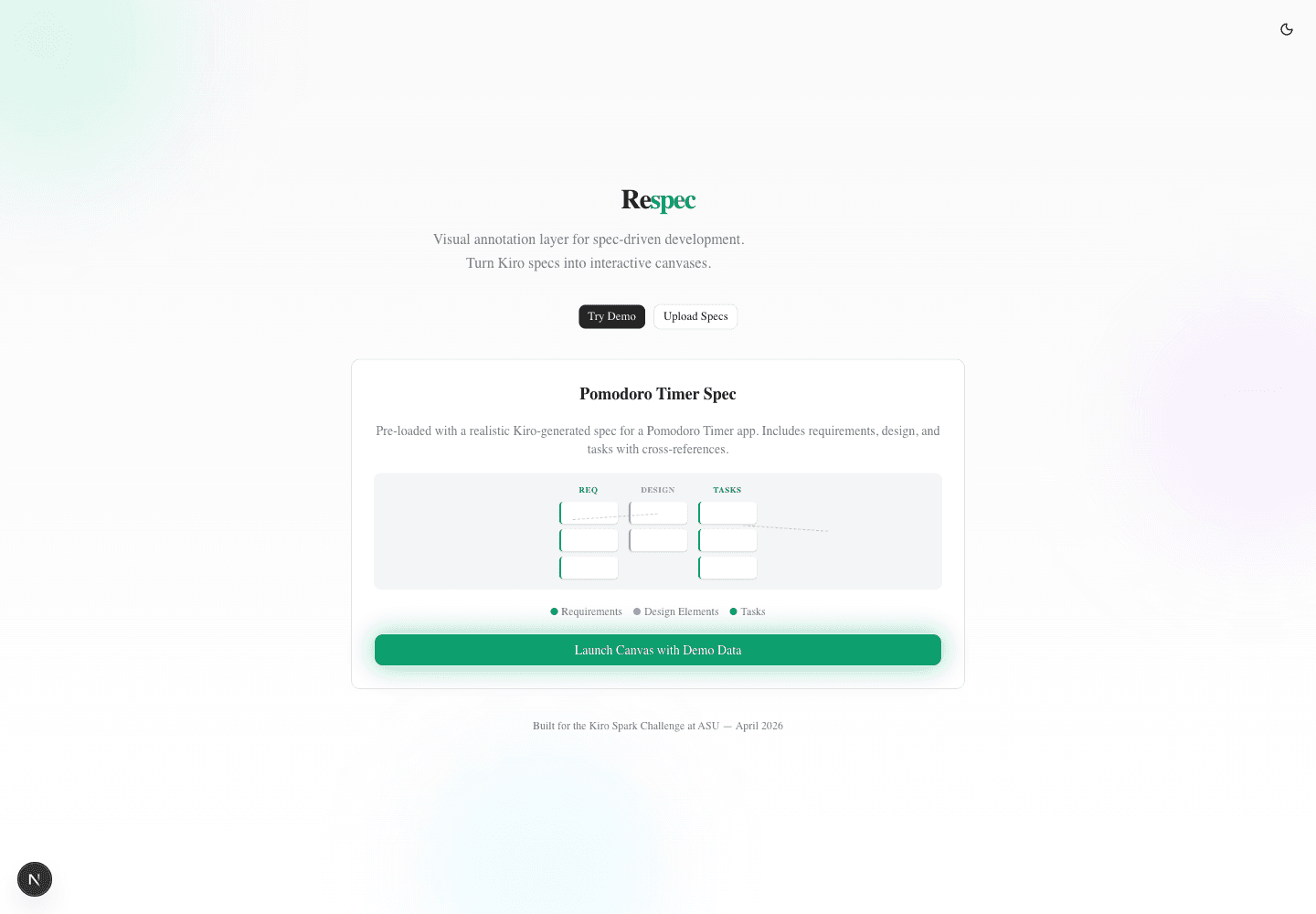
A visual review tool that turns Kiro-style spec files (requirements, design, tasks) into an interactive canvas for reviewing, annotating, and approving specs, with a VS Code extension and a web demo.
- TypeScript
- Next.js
- React
- VS Code Extension API
- Vercel
The idea
Kiro writes specs as three Markdown files: requirements.md, design.md, and tasks.md. That's a fine format for a machine to produce and a rough one for a human to read. Everything connects to everything, but a document only shows you one line at a time. To check whether task T-6 actually implements requirement FR-2.1, you're scrolling between three files and holding the map in your head. Miss one link and a whole requirement ships with nothing built for it. Respec takes those same three files and lays them out on a canvas so the structure is visible enough that the cheap fix is the one you reach for.
The review loop
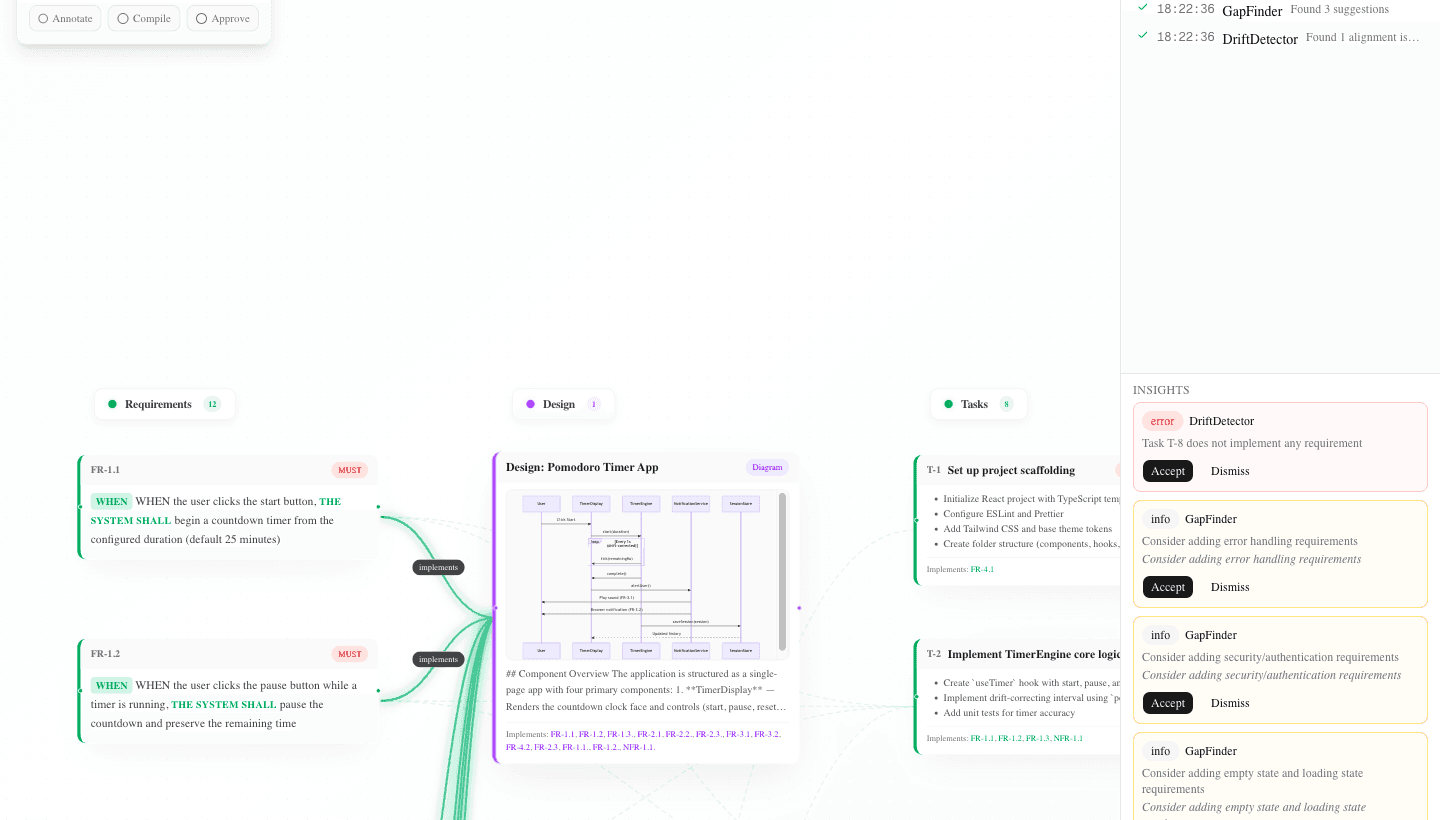
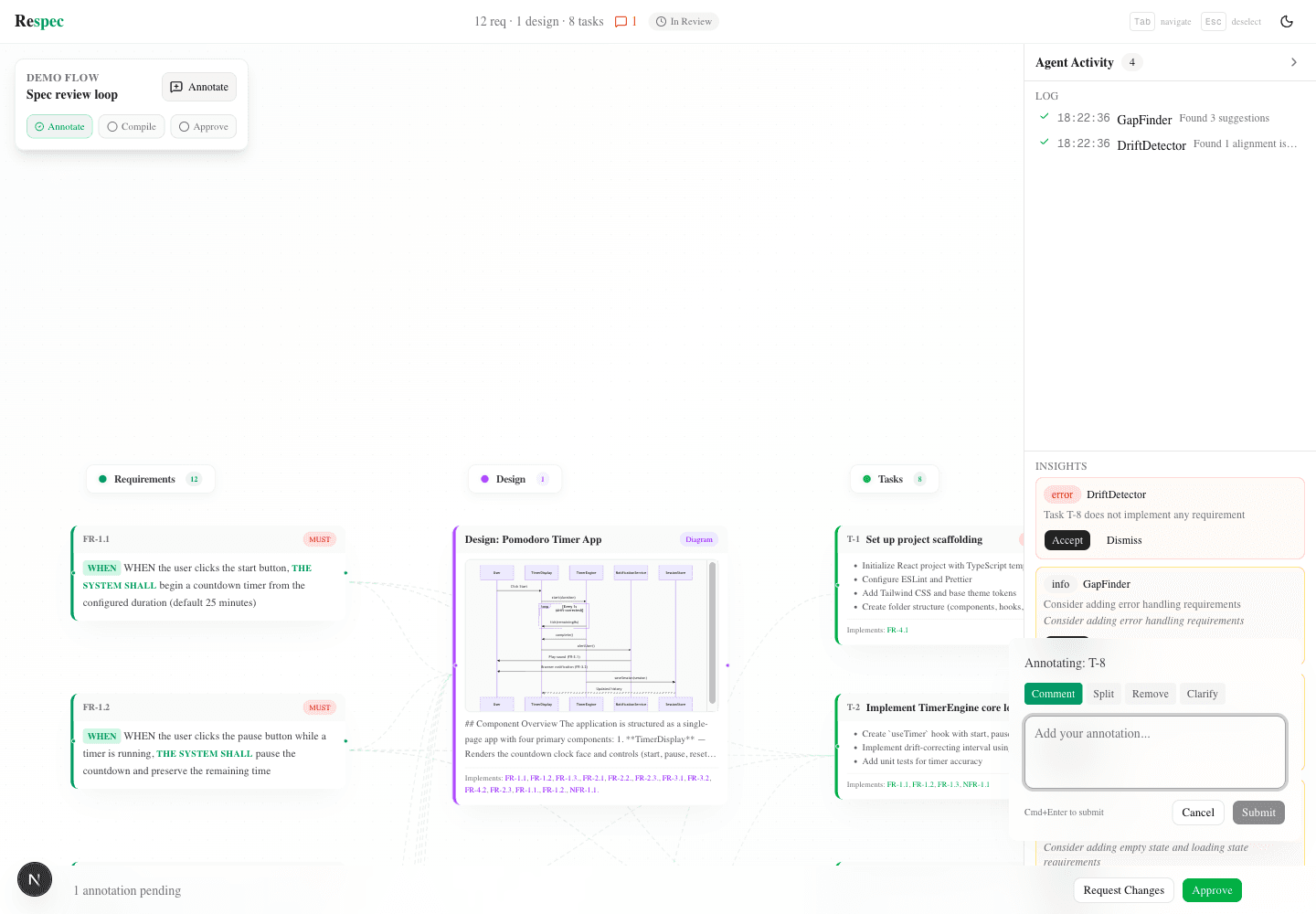
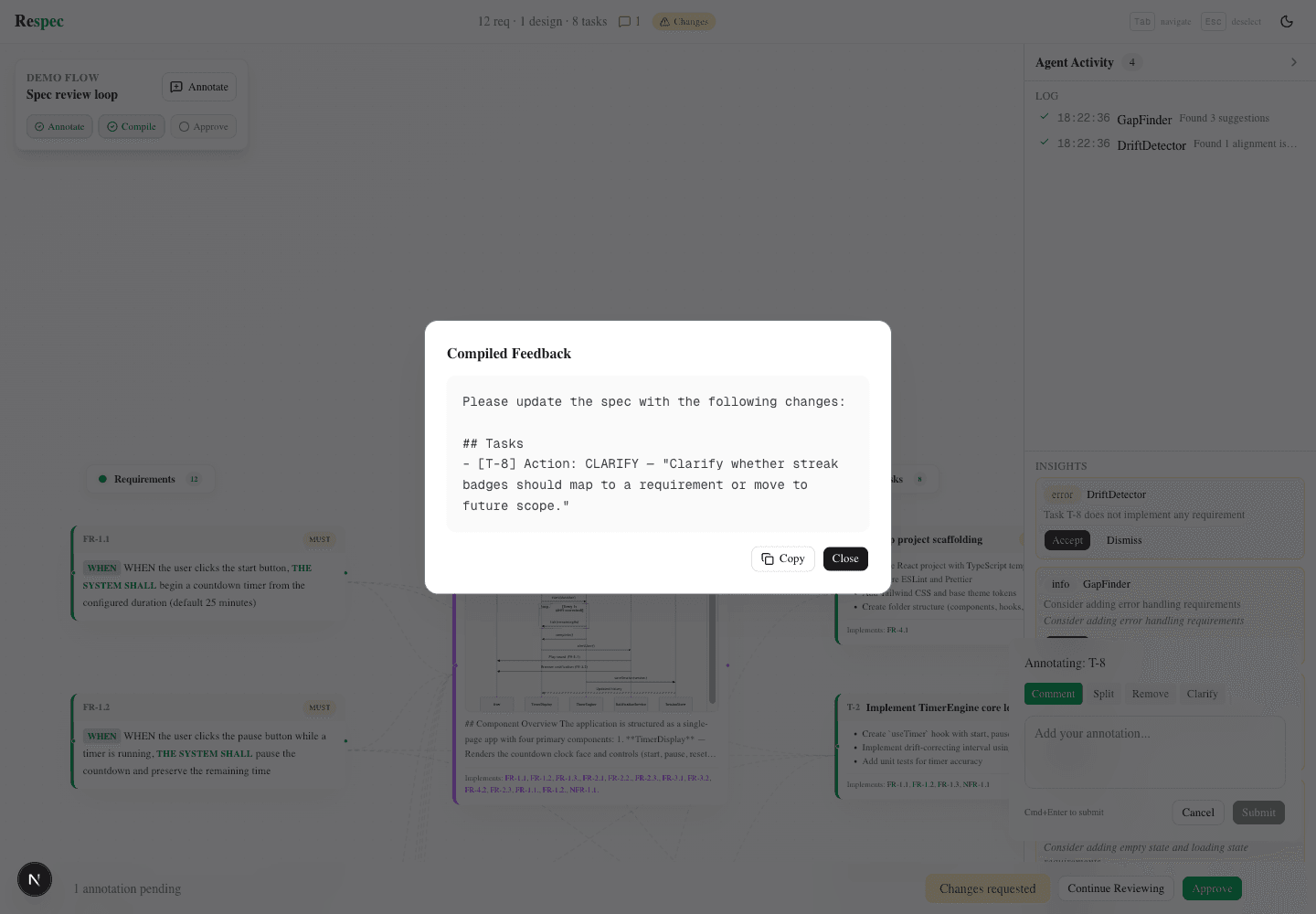
Respec converts Kiro-style spec files into a three-column interactive canvas, with requirements on the left, design in the middle, and tasks on the right, and lines drawn between the things that reference each other. You review on the canvas, annotate issues right on the cards, then compile your annotations into a clean feedback document you can download or paste straight back into Kiro, or approve the spec and hand off an approval artifact.
On the canvas
- Hover a requirement and its links light up while everything unrelated dims, so you can see exactly what implements it
- Two rule-based agents, DriftDetector and GapFinder, scan the spec and flag the gaps: a task that implements nothing, a requirement nobody built
- Four annotation types (comment, split, remove, clarify) capture intent rather than freeform notes, so feedback can be compiled and replayed
- FeedbackCompiler turns your annotations into a structured Markdown document ready to download, copy, or feed back into Kiro or another agent
Why it's built this way
- Kept the demo agents deterministic so reviews are reproducible during the hackathon, with the architecture leaving a clear path to Bedrock/Claude-powered agents later
- Carried review state through the URL instead of a backend, so shared links rebuild the exact annotated canvas with nothing to log into
- Built for the Kiro Spark Challenge at ASU as a team, MIT licensed